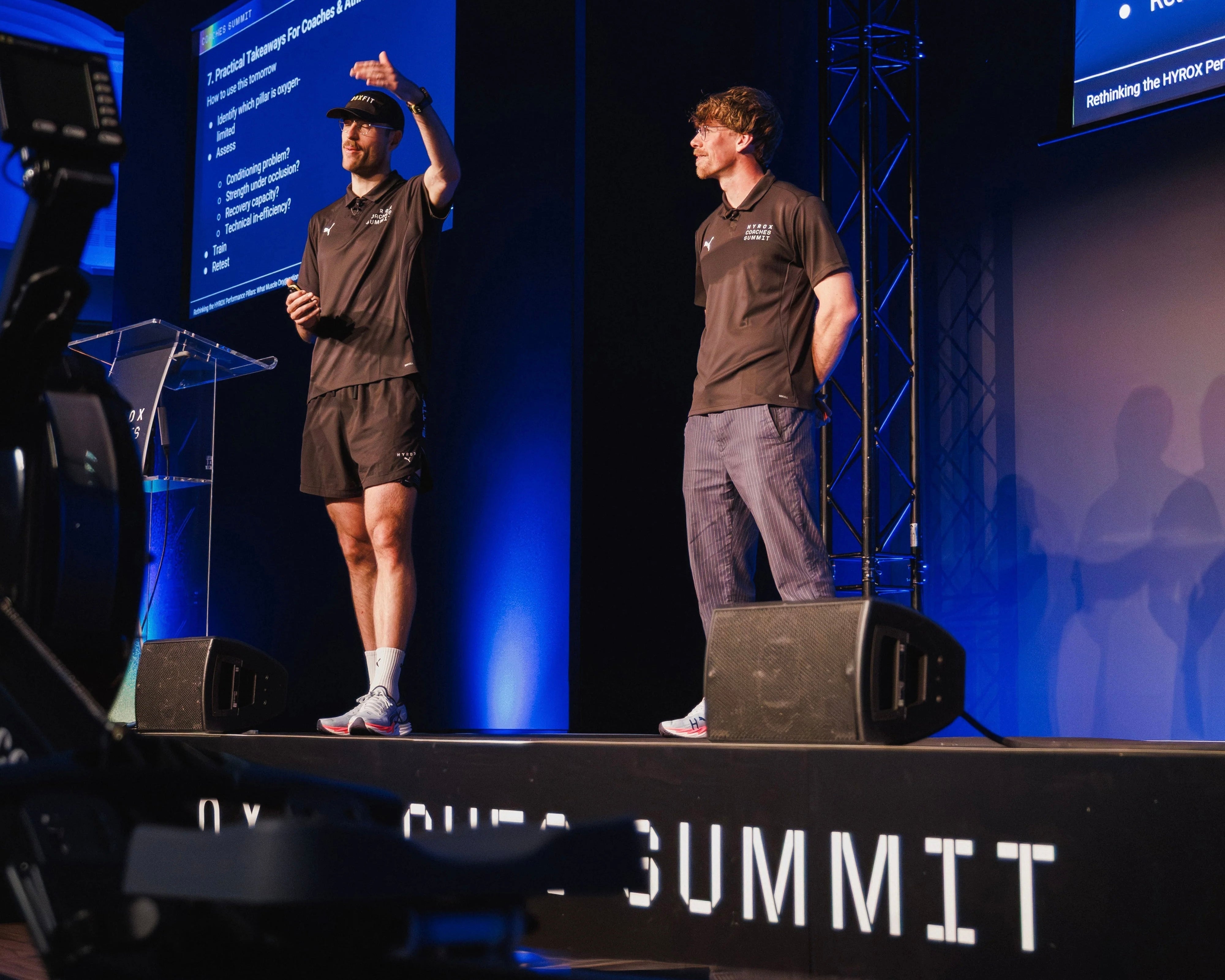
At the HYROX Elite Doubles race in Warsaw, Train.Red athletes Hidde and Thierry secured 2nd place.
That result matters.
But more importantly, how that result was achieved is what reflects where performance in HYROX is heading.
Because this wasn’t just a race.
It was a live validation of how we train.
Measuring What Actually Drives Performance
HYROX performance is often judged on visible outputs:
- Split times
- Station efficiency
- Running pace
But these outputs don’t explain why performance unfolds the way it does.
Using muscle oxygenation (SmO₂), we track what’s happening inside the muscle during both training and racing:
- Local fatigue development
- Oxygen extraction capacity
- Recovery between efforts
- Station-specific physiological demand
This allows us to move away from assumptions, and train based on what is actually limiting performance.
What the Race Data Shows

The gaph above compares SmO₂ data from both athletes during the race.
Two key observations stand out immediately:
1. Different Athletes, Different Profiles
Even at the same race intensity, the physiological response is not identical.
- One athlete consistently operates at lower SmO₂ values, indicating higher oxygen extraction and local muscular demand
- The other shows more fluctuation and higher peaks, suggesting different recovery dynamics and distribution of load
This is critical.
Because it confirms that even in a doubles format — with shared workload —
the internal cost of that workload is not the same.
2. Station-Specific Stress Becomes Visible
The repeated drops and recoveries in the graph highlight the true cost of HYROX stations.
Some efforts create:
- Deep desaturation → high local fatigue
- Followed by incomplete recovery before the next effort
Over time, this compounds.
Without this data, these moments are often interpreted as:
- “bad pacing”
- “lack of conditioning”
But in reality, they are often local muscular limitations.
3. Fatigue Is Not Linear
One of the most important insights:
Fatigue does not build in a straight line.
There are clear moments where:
- SmO₂ drops more aggressively
- Recovery becomes less effective
- Variability increases
These are the points where races are decided.
And they are trainable — if you can identify them.
From Training to Race Execution
This race wasn’t an isolated performance.
It was the result of:
- Tracking these patterns in training
- Identifying individual limitations
- Adjusting workload and intensity distribution accordingly
By consistently measuring:
- How deep an athlete desaturates
- How quickly they recover
- How repeatable their efforts are
We can objectively track progression over time.
Not just:
“Are you getting faster?”
But:
- Are you becoming more efficient at the muscular level?
- Are you delaying fatigue onset?
- Are you recovering better between efforts?
Training as a Team, Not as Individuals
One of the biggest advantages becomes clear when multiple athletes train with the same system.
Comparing data between athletes (like Hidde and Thierry) allows us to see:
- Who is stronger in sustained efforts
- Who recovers faster between stations
- Who experiences deeper local fatigue under load
This changes how we approach doubles racing — and training in general.
Instead of guessing:
- Who should take the lead
- Who should push which stations
We can base decisions on objective physiological profiles.
The Future of HYROX Performance
The takeaway from Warsaw is simple:
Performance is no longer just about output — it’s about understanding the system behind it.
The combination of:
- Race execution
- Training data
- Athlete comparison
creates a feedback loop that continuously improves performance.
2nd place is the result.
But the real progress is in:
- how we train
- how we analyze
- and how we make decisions
Because as the level in HYROX continues to rise,
the athletes who understand their physiology — will outperform those who don’t.